"I don't want comfort. I want God, I want poetry, I want real danger, I want freedom, I want goodness, I want sin."
Aldous Huxley's Brave New World, along with George Orwell's 1984, remain the two cornerstones of 20th century dystopian future, with each having a very different take on the horror that the modern world could progress to. Brave New World's future is a sterile one, with consumerism and comfort being emphasised whilst "smut" such as religion and family life is banned, the words themselves reduced to crude obscenities. In this world everything is mass produced, including people, and Henry Ford, proponent of the assembly line and the father of mass production, is revered as a kind of god.
The novel opens with a description of the "Central London Hatchery" in which eggs are fertilised by machines and the perfect amount of people of varying intelligence are created to maintain the current population of the planet. From this introduction the story turns to Bernard Marx, a man whose lacklustre appearance has led to him being a social outcast, which in turn has made him question the society of subliminal messaging and meaningless entertainment in which he lives. Bernard's friend Helmholtz Watson also questions the system, not because he has any physical deficiency but rather mental excess, and throughout the novel Bernard's put upon, self pitying attitude is contrasted with the genuine philosophical curiosity of Helmholtz. The third major character is John, a man who has grown up on a reservation for "natives" and as such has no knowledge of advanced society, instead living in a kind of tribe in New Mexico, safely fenced off from the outside world.
Whilst most Science Fiction novels have a character who does not understand the world they are in, in order to allow the author to indirectly explain how things work to the reader (such as Arthur Dent in The Hitchhikers Guide to the Galaxy) Huxley instead introduces John late enough in the novel that his ignorance is not the readers ignorance. Concepts such as "Obstacle Golf", "feelies" and "soma" have already been introduced to the reader, which serves to highlight the incredulous attitude of those who come into contact with this peculiar native who has no knowledge of the modern world. Having said this, those living within society have no knowledge of Shakespeare or religion, and consider marriage, monogamy and intimacy disgusting and obscene concepts. This cultural clash is brought to a head when a woman called Lenina, conditioned from birth to have as many sexual partners as possible, attempts to sleep with John, horrifying him. In a panic, he resists her advances, frantically quoting passages from Shakespeare before struggling free and fleeing.
Brave New World hits home because of its fundamentally human characters, with the tragic figure of John, trying desperately to find meaning in a meaningless world that treats him as no more than an amusing curiosity, being the most hard hitting of them all. The world itself also manages to be even more disquieting than that of 1984 as it is a hyperbolic version of our own, a nightmare of meaningless pleasure and enforced consumerism made all the more real by just how easy it is to imagine. The majority of readers will side with John's idea that freedom, art and pain are superior to meaningless comfort, but explaining why is something that both he and the reader may find harder to pin down.
 “What really knocks me out is a book that, when you're all done reading it, you wish the author that wrote it was a terrific friend of yours”
The Catcher in the Rye is American writer J.D.Salinger's most famous work, the controversial story of 3 days in the life of Holden Caulfield, a seventeen year old boy who also narrates the book, addressing the reader directly throughout. A modern day coming of age novel, the book is often derided for appealing to the pretentious child who has just discovered the cultural capital a book can bestow, more a prop for the pocket of a jacket than true literature, with reasons pointed to including the supposed lack of a 'moral' or 'message' and the subversive nature of the text.To properly address the criticisms levelled at the would be time consuming and pointless, and what is below is my personal reasons for enjoying the book, rather than a point by point rebuttal to those who don't.
The Catcher in the Rye hinges on its central character, told as it is from the first person perspective, with heavy use of colloquialism and slang. this choice to frame the book as an almost autobiographical work of the fictional protagonist contributes greatly to its lasting appeal, with the style of Caulfield being unique and endlessly memorable. this personal touch can be seen from Holden's dismissal of the majority of humanity as "phonies" to his joyful exaggeration of feeling that manages to capture the teenage mindset in a way no author has managed before or since. Indeed at the moment when Holden arbitrarily decides that he doesn't want to visit the museum he's been extolling the virtues of for almost an entire chapter he simply says "all of a sudden I wouldn't have gone inside for a million bucks" an irrational mood swing that anybody who can recall their teenage years will be able to empathise with infinitely. This creation of a living, breathing character is the secret to The Catcher in the Rye's enduring appeal, as whilst the reader may not be able to identify with the world of prep schools, record buying and picture houses Salinger so masterfully creates it's impossible not to identify with the bewildered, jaded, cynical and undeniably human 17 year old kid he places into this world.
Many who dismiss the book have levelled the criticism that its problem is that Caulfield is just not likeable enough, pointing out that he is often selfish, rude and rebellious, but this is exactly the point. The protagonist is at times unlikeable because he is a 17 year old boy, and what 17 year old boy have we ever known, or indeed been, who has not been full of themselves, stubborn and annoying? In crafting an accurate picture of a teenager Salinger has crafted a character that everyone should be able to empathise with, not because he is like us now, but because he is like we were once, The Catcher in the Rye does not seek to tell a story, it seeks to create a character. In short the 3 days in Holden Caulfield's life are not interesting because of what happens, but because of who they happen to, and therein lies the true genius of this great American novel.
"a step backward, after making a wrong turn, is a step in the right direction.”
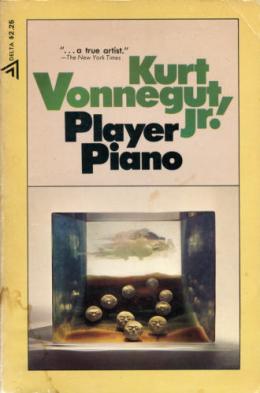
Player Piano was Kurt Vonnegut's first published novel, and is set in the factory town of Ilium, New York in the near future. In this future scientists and engineers have created machines that now do the vast majority of tasks, leaving most people to either work for the reconstruction and reclamation corps or the army, neither of which serve a purpose besides occupying those who would otherwise be unemployed. Those who do have meaningful jobs by and large oversee the work of machines, which is the position that protagonist Paul Proteus is in when the novel opens. Whilst Proteus' future is bright and he outwardly seems to believe in the society in which he takes part he feels a growing sense of unease with the pointlessness of it all and the alienation of the common man, yearning for some way to break free. When an old friend, Ed Finnerty, comes to see Paul and announces he has left his job it sends Paul towards a revolutionary struggle against the system in a manner more than slightly reminiscent of Huxley's Brave New World.
Whilst the plot may not be original Vonnegut's inimitable style and the slightly closer to home setting of the novel turn it into a very different creature, acting more as a social satire than a heartfelt cry against the system. The machines in Player Piano are still punch card operated and it is not set in a future too far removed from the time when the book was published (1952), leading to a setting less detached from reality than many dystopian novels achieve, which lends weight to the sometimes irreverent style of the novel. The supporting characters are just as three dimensional as Proteus himself, with his wife and their relationship seeming truly plausible and human, and the feeling of despair and rootlessness that Proteus seems to feel resonate strongly with the reader, again helping to stop the book being simply a dry social commentary and instead making it a truly gripping story.
Player Piano is not nearly as polished as Vonnegut's later work, such as Slaughterhouse five, with a side story involving the Shah of a foreign country seeming particularly out of place, but all in all it holds up incredibly well and makes an interesting addition to the genre of dystopian fiction. By the end of the novel Player Piano Seems not to be anti-technology or anti-progress, but rather anti-stupidity, as only Vonnegut could envision.
'Mediocrity is like a spot on your shirt, it never comes off.'
Dance Dance Dance Is a novel by Japanese author Haruki Murakami, first published in 1988. It follows the life of an unnamed narrator as he struggles to make sense of the world around him, and his place within it. Combining a cast of offbeat characters with a world that frequently comes across as unsettling and grim results in possibly the darkest of Murakami's books, but also one of the best, yo-yoing from gripping to disquieting and back again in the space of a few pages, yet managing to be incredibly entertaining throughout.
The world of Dance Dance Dance seems to take aspects of the genre of magical realism, weaving ordinary events with plot devices that would be impossible in the real world. This does not detract from the novel however, with each new impossibility being presented into the book as if it belongs there, with even the bemused narrator accepting such oddities as a clairvoyant 13 year old, or another world accessed through the lift of an expensive hotel. While these concepts seem ridiculous, their placement in a book that is otherwise firmly rooted in reality reduces this improbability, until by the end of the book the reader accepts such concepts as matter of fact, rather than out of place, ultimately enhancing the feel of subtle unease that pervades the text.
The story itself plays out as a series of forking paths, with each being visited in turn, it isn't that there is no coherent plot, but more that this plot is often sidelined in favour of such events as a detour to Hawaii, or a rendezvous with a call-girl. It is to Murakami's credit than none of these deviations seem frivolous or unnecessary, and the way in which he manages to link the vast majority of these unconnected events by the end of the novel is nothing short of masterful, with the reader at no point feeling lost or frustrated. The ever present narrator is the main method by which these seemingly unrelated scenes are brought together, and by the end of the novel one feels close enough to the unnamed protagonist that his experiences truly seem to matter.
If there's one criticism of Dance Dance Dance it is that at times the pacing does seem to be inconsistent, with one scene in a police station dragging on for longer than necessary, but this is a small and infrequent complaint, and does not detract from the overall brilliance of the Novel. the book seems to be written by the author, for the author, yet gives the reader a well crafted window into another's perspective. To quote the narrator 'I don't give a damn about what people say. They can be reptile food for all I care'. It is precisely this attitude that makes Dance Dance Dance such a pleasure to read.
"The writer, after writing, finds that he is the poorest of men.”
The debut novel of the 20th century novelist Italo Calvino, The Path to the Spiders' Nests is set in Italy during the Second World War and finds the protagonist, a young boy named Pin, embroiled in the conflict between the Fascists and Partisans. Despite this rather grim setting the novel manages to swing between haunting images of wartime brutality and the genuinely funny passages based around a young boy's utter confusion at adult infatuation with women and fighting, and their disregard of things Pin considers important, such as the titular area in which the spiders make their nests.
Pin is an orphan living in a small Italian town, with his only remaining family member being his abusive sister, the neighbourhood whore. Due to this unorthodox upbringing Pin is shunned by children his own age, and instead spends his time at the local bar, entertaining and infuriating the men who drink there. This is the scene as the novel begins, but the arrival of the war to this sleepy town leads to Pin's arrest for stealing a pistol, and subsequently to his escape and residence with a ragtag group of Partisans, considered such a danger to the cause that they are denied any real role in the plans of the Communist resistance.
Anybody familiar with Calvino's later work can see that the plot of The Path to the Spiders' Nests is one of the authors less surreal works, but this is not to say that it lacks the charm of later novels such as If on a Winter's Night a Traveller, rather that it channels this charm in a different way. Throughout the story Calvino uses Pin's young age as a device to allow numerous secondary characters to explain ideas and experiences as diverse as Communism, love and writing to him, many of which seem to be the Author speaking directly to the reader and trying to get across his own point of view. In one of these monologues a character confides his reasons for fighting, saying "I may not accomplish great deeds but history is made up of little anonymous gestures" a passage that really hammers home what Calvino is trying to write, not so much a war novel as a novel detailing part of the life of one anonymous child caught up in the death and destruction of World War Two, and at this it succeeds enormously well.
The Path to the Spiders' Nests is not perfect however, with the simplicity of the main character at times growing slightly tiresome, and an ending which seems the work of a writer of far lesser talent than Calvino, leaving a real sense of disappointment when one turns the page and realises that the novel is in fact finished. These shortcomings can be attributed to Calvino's inexperience at the time of writing however, and if considered against the book as a whole, these complaints are minor. Overall The Path to the Spiders' Nests is well worth reading, and if it does not reach the heights of Calvino's later work, this is more a reflection of their brilliance than this books failings.
"thank God that I can read, that I have truly touched the minds of other men.”
Perhaps more famous for his novel turned film The Man Who Fell To Earth, Tevis is one of the few science fiction writers who can truly be said to break into the realms of literature, as opposed to simple fiction. Mockingbird was written in the years leading up to Tevis's death from cancer and as such has a rather bleak tone, focusing on the themes of depression and heartbreak in a society in which even looking somebody in the eye is considered a gross invasion of privacy. Set in a dystopian future in which humanity is infertile, apathetic and on the slow path to extinction Mockingbird reads like an unofficial sequel to both Brave New World and Fahrenheit 451, taking the former's theme of chemical dependency and the criminalisation of love coupled with the latter's abhorrence of books and intellectualism in general to create possibly one of the most depressingly plausible "what-if" novels ever written . Humanity's decline is due to the whim of those alive hundreds of years previous to the time in which the novel takes place and has been caused by the creation of robots to cater to every need, leaving the population with nothing productive to do. This leads to the the belief that it is better to take drugs and forget the world, rather than deal with the possibility of pain and boredom that accompanies lucidity.
The novel itself follows the lives of 3 characters who reject this doctrine, a "make nine" robot named Spofforth, the most intelligent android ever created and almost human in complexity, a university professor named Bentley who commits the crime of teaching himself to read and the woman Bentley befriends and falls in love with, named Mary Lou. Alternating between the viewpoints of these 3 characters, Tevis' novel does what any good dystopian novel strives to do, reveal something about the world we live in by taking it to its logical extreme. indeed Mockingbird seems to be a cry of despair from the author, who wrote in The Man Who Fell To Earth “The strange thing about television is that it doesn't tell you everything.” And indeed throughout the novel it is shown that the entirety of humanity does nothing but take pills, watch television and let civilisation crumble around them, with only Bentley and Mary Lou seeming to understand the horror of their existence.
The brilliance of Mockingbird is that it taps into many readers sense of despair at the modern world without coming across as sanctimonious or pretentious, the reader is left to decide whether the pain, heartbreak and occasional depression felt by the main characters is preferable to the listless existence of the masses, and Tevis uses the alien backdrop of the society he has crafted to bring into focus the truly human relationships of these characters, giving the novel a romantic overtone that is present throughout . It takes a truly great writer to craft a character so human that one feels they can truly understand why they feel as they do, and Tevis manages this with not just 1, but 3 characters, as well as crafting a world that is truly unsettling in its plausibility, an incredible feat and one that deserves recognition.




.jpg)