Wednesday, 2 March 2016

"Not a Prophet or a Stone Aged Man”: In Memory of David Bowie

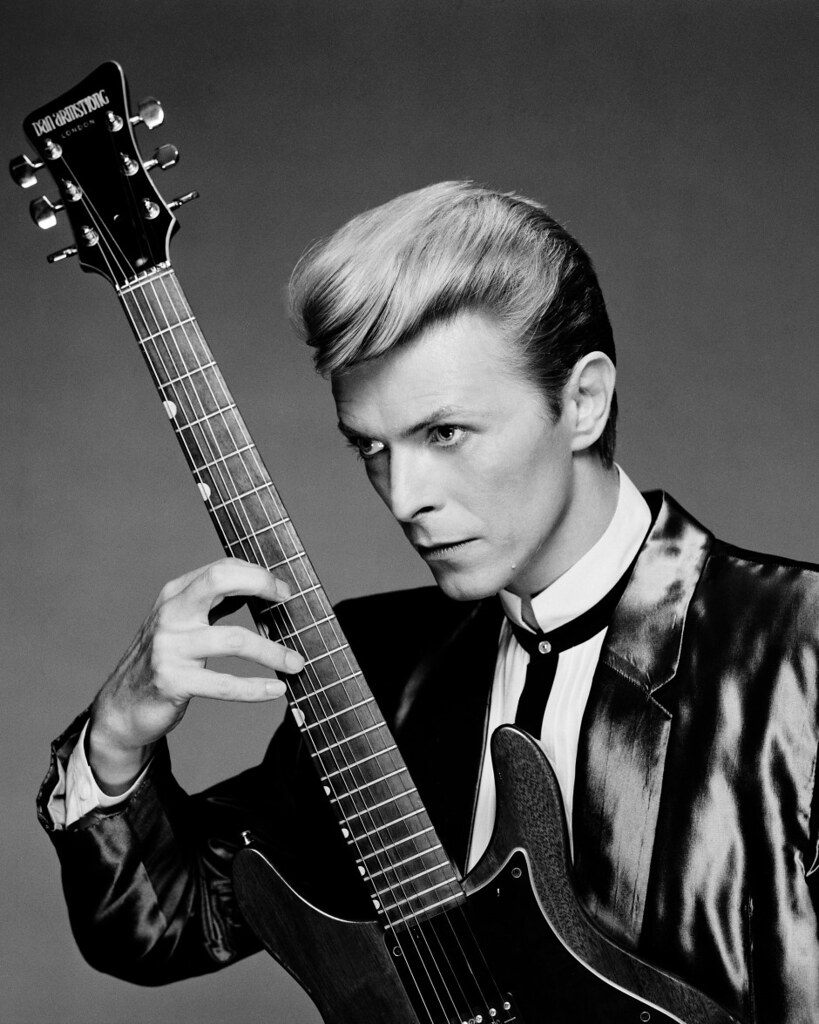
Credit to Ron Frazier
David Bowie, singer, songwriter, actor and full time extra-terrestrial-posing-as-human sadly left us on the 10th of January, leaving the world a decidedly less colourful place. Whilst I’m sure you’ve all seen tributes from the likes of Kanye West all the way to Prime Minister David Cameron I think Bowie may be one person who can never be written about too much, and who deserves every note of over the top praise he receives. With that in mind, what follows is a memorial to the man who was born David Jones in South London and proceeded to change the landscape of both music and culture forever, written by a self-confessed and entirely biased fan of the man and his music.
The musical landscape of England in the last 50 or so years is a hell of a ride, from Rockers to Punks, Skinheads, New Romantics, Ravers, Indie and everything in between, but through it all Bowie managed to stay relevant (save a few years in the 90’s, but we won’t talk about that) and even managed to release a bizarrely cutting edge album on his 69th birthday, an age at which I’ll probably be worrying about whether or not BBC Four will have a documentary on steam trains that night. I won’t go into a full run through of his Number 1 hits in the UK because there probably isn’t enough space in this whole paper for that, let alone in this one piece, but asking people their favourite Bowie Song merits such a variation of answers that it’s amazing that we’re all talking about the same artist, and even more amazing that he was so consistently not just good, but great. Add into this Bowie’s varied film career (Labyrinth and The Man Who Fell to Earth spring to mind, not to mention a brilliant cameo in Zoolander) and you’re looking at somebody that could be called the most influential pop culture icon of the last 50 years without much competition. His sheer sense of style and persona throughout the half century he was active were varied to the extent that he gained the nickname “The Musical Chameleon” and the entire theme of a fancy dress party could be “come as David Bowie” and, aside from ten or so lightning bolt clad Aladdin Sanes you’d be hard pressed to find two people that look alike.

I guess what I’m trying to say in this article is that David Bowie’s death is a cataclysmic event in the landscape of popular culture, but rather than mourn the fact that he isn’t here anymore, we should celebrate, safe in the knowledge that at least he was here in the first place.  In the words of the man himself “I’m happy, hope you’re happy too”.
(Originally published in The Spark*)

Review-Adrenalin Baby-Johnny Marr Live

Press release image
Johnny Marr, best and most fondly remembered as the guitarist and co-writer for The Smiths, has mounted somewhat of a comeback over the last few years, with two solo albums both well received by critics and fans alike. Adrenalin Baby is somewhat different, being a live album recorded from Marr’s tour and including hits from The Smiths’ back catalogue as well as his own and even featuring a cover of The Clash’s famous song I Fought The Law, but the real question is: how well does it hold up?

The answer is surprisingly well, as a confusingly long barrage of noise at the start of Playland soon gives way to a punchy sound that blends Marr’s considerable talent on the guitar with surprisingly slick vocals reminiscent of a pumped up and slightly more in tune Noel Gallagher, although that could be just be due to the Mancunian connection between the two. Between songs the crowd are enthusiastic and the man himself offers a few choice phrases but this crowd noise is only present between numbers and is not allowed to interfere with the songs themselves, meaning you never feel like you have to fight through the cheers to get at the music, an annoyance that many live albums  suffer from.

Marr’s performance on Smiths classics like Bigmouth Strikes Again and There is a Light That Never Goes Out is equally good, with Marr’s guitar being as inimitable and brilliant as ever and his vocals doing a surprisingly good job of fitting the song without devolving into a poor man’s Morrissey karaoke set, something that is easily done (it’s also nice to be able to hear the lyrics that often get lost in Morrissey’s trademark warble). The Post-Smiths offerings are in places just as good and Adrenalin Baby plays like something of a greatest hits for a man that has been active in the industry for so long and has often been unfairly overlooked. Whilst waiting for the first song by The Smiths you realise that Johnny Marr’s made some damned good songs (listen to New Town Velocity and you’ll see what I mean) and many of them may have passed you by, I know they did me.


Overall Adrenalin Baby is a great introduction to Johnny Marr’s solo career and just goes to show that even if he doesn’t make the headlines as much as Morrissey, and may not have the same rabid fan base, he’s still a hell of a musician and a pleasure to listen to. From somebody that has seen Marr live I can also attest to the fact that the crowd reaction in this album isn’t at all staged, he really is that good live and I’d recommend both his live set and this live album to anyone.

(Originally published in The Spark*)

Wednesday, 17 February 2016

Review-Maribou State at Purple Turtle, Reading- 16th February 2016

Maribou State at The Art School, Glasgow in 2015
Picture: Matthew Swan/Flickr
Electronic duo Maribou State played a warm-up gig for their upcoming UK tour on Tuesday, taking to the (admittedly small) stage of Purple Turtle in Reading for a live set. Hard to pin down as far as genre goes, Maribou State’s online descriptions range from garage to instrumental hip hop to contemporary R&B, but sound-wise they slot easily into place as a more downbeat Disclosure, something like Bondax on a comedown, or a slightly less orchestral take on Bonobo.

Support was from the excellent Twin Sun, who described themselves as “unpretentious and summery” although Pete Wheeler, one half of the duo, said he preferred my initial impression of “Being inside a cartoon spaceship”, so pick whichever of those you prefer. Maribou State (billed as “Ian & I” in perhaps the worst kept secret set of all time) came on at around half ten, playing an hour long set complete with live drummer and an array of guitar pedals that were confusing to look at, let alone use. Being at a gig that fits more into the “3am start and a bucket of MDMA” category at half ten after only a couple of pints was a strange experience, although as somebody that isn’t a huge fan of the genre it was nice to be able to stand and appreciate what was happening without a stranger telling me how much they love me whilst chewing through their own tongue. The music itself was enjoyable and it was impressive seeing how well something clearly originally made on a laptop translated into a traditional band setup, and even if it was reverse engineered it did somehow seem more authentic than a DJ set, which can only be a good thing.

The highpoint of the gig were the songs with vocalist Holly Walker, who added a focal point that some of the set was lacking, and actually managing to get a relatively sober crowd dancing and singing along to a remix of “Praise you” by Fatboy Slim towards the end, even if she did have to ask everyone politely to join in before they let themselves have a bit of fun. The feeling of the set being a warmup for bigger things was definitely there and I’d say that their upcoming gigs will probably be better, but that’s to be expected at an event that’s clearly intended to test out their set before sold out gigs around the country and hey, for a free entry gig on a Tuesday night it was still good fun, so I can hardly complain.

Overall if you’re a fan of Maribou State, Tuesday’s gig probably wasn’t the best place to go and see them, with a pretty static crowd and an early set time making it more of a taster for people that are on the fence than a night out for the converted. Having said that the songs were good, the playing was incredibly tight (especially considering they didn’t start out as a live act) and the people there were definitely enjoying themselves, even if they were just tapping their feet and sipping a vodka coke rather than shuffling manically with a bottle of water in their hand as I feel the crowd at their future gigs may well be.

Both acts are on Soundcloud:
You can listen to Twin Sun here: www.soundcloud.com/twinsunmusic
and Maribou State here: www.soundcloud.com/mariboustate

Saturday, 13 February 2016

Review-Tame Impala at The Alexandra Palace- 12th February 2016


Australian psychedelic rock Band Tame Impala took over the Ally Pally last night, playing a sold out gig to thousands and clearly having the time of their lives. Support was from the excellent Jagwar Ma, although thanks to the delights of London’s public transport system we managed to arrive as they walked off stage, which was hardly ideal.

Refusing to be put out by our late arrival we forced our way through the crowd and waited for the main event. When Tame Impala came on they did so accompanied by a light show straight out of a 1960’s LSD trip and started with into one of the biggest songs from their newer album, the stellar “Let it Happen”. The crowd reaction was incredible, but slightly bizarre, with almost a mosh-pit opening up at the front and people leaping around as if it was 1977 and the Sex Pistols had just launched into “Anarchy in the UK”, not what I was expecting from the decidedly mellow, psychedelic feel of Tame Impala. This was the first of a few times during the gig that the band seemed a bit out of place in the traditional gig setting, their set was tight, the songs were great and lead singer Kevin Parker’s rapport with the crowd was undeniable, but it seems strange that a band whose frontman is listed as playing “Vocals, Guitar and Kazoo” on their Wikipedia would provoke such an energetic and at times violent response. The security at the gig also detracted from the free-love aesthetics of the visuals and music, demanding that nobody get on each other’s shoulders, crowd surf or breath in the wrong direction, perhaps understandable when trying to police such a massive crowd, but still a bit of a mood killer.

Overall Tame Impala played a fantastic set, with an encore consisting of the old favourite “Feels Like We Only Go Backwards” coupled with new song “New Person, Same Old Mistakes” and a blast from two massive confetti cannons summing up the exuberance and fun that should have permeated the whole gig. Unfortunately a cold February night and a ten thousand strong crowd don’t easily gel with the band’s sound, and no matter how great they were there was always the feeling that really, you’d rather be listening to them whilst lying in a field on a summers day with a cold pint in one hand, not standing jammed into a sweaty teenagers armpit drinking warm Carlsberg out of a paper cup whilst an overenthusiastic fan elbows you in the kidneys from behind.

Monday, 2 February 2015

Novel: Brave New World

"I don't want comfort. I want God, I want poetry, I want real danger, I want freedom, I want goodness, I want sin."

Aldous Huxley's Brave New World, along with George Orwell's 1984, remain the two cornerstones of 20th century dystopian future, with each having a very different take on the horror that the modern world could progress to. Brave New World's future is a sterile one, with consumerism and comfort being emphasised whilst "smut" such as religion and family life is banned, the words themselves reduced to crude obscenities. In this world everything is mass produced, including people, and Henry Ford, proponent of the assembly line and the father of mass production, is revered as a kind of god.


The novel opens with a description of the "Central London Hatchery" in which eggs are fertilised by machines and the perfect amount of people of varying intelligence are created to maintain the current population of the planet. From this introduction the story turns to Bernard Marx, a man whose lacklustre appearance has led to him being a social outcast, which in turn has made him question the society of subliminal messaging and meaningless entertainment in which he lives. Bernard's friend Helmholtz Watson also questions the system, not because he has any physical deficiency but rather mental excess, and throughout the novel Bernard's put upon, self pitying attitude is contrasted with the genuine philosophical curiosity of Helmholtz. The third major character is John, a man who has grown up on a reservation for "natives" and as such has no knowledge of advanced society, instead living in a kind of tribe in New Mexico, safely fenced off from the outside world.

Whilst most Science Fiction novels have a character who does not understand the world they are in, in order to allow the author to indirectly explain how things work to the reader (such as Arthur Dent in The Hitchhikers Guide to the Galaxy) Huxley instead introduces John late enough in the novel that his ignorance is not the readers ignorance. Concepts such as "Obstacle Golf", "feelies" and "soma" have already been introduced to the reader, which serves to highlight the incredulous attitude of those who come into contact with this peculiar native who has no knowledge of the modern world. Having said this, those living within society have no knowledge of Shakespeare or religion, and consider marriage, monogamy and intimacy disgusting and obscene concepts. This cultural clash is brought to a head when a woman called Lenina, conditioned from birth to have as many sexual partners as possible, attempts to sleep with John, horrifying him. In a panic, he resists her advances, frantically quoting passages from Shakespeare before struggling free and fleeing.

Brave New World hits home because of its fundamentally human characters, with the tragic figure of John, trying desperately to find meaning in a meaningless world that treats him as no more than an amusing curiosity, being the most hard hitting of them all. The world itself also manages to be even more disquieting than that of 1984 as it is a hyperbolic version of our own, a nightmare of meaningless pleasure and enforced consumerism  made all the more real by just how easy it is to imagine. The majority of readers will side with John's idea that freedom, art and pain are superior to meaningless comfort, but explaining why is something that both he and the reader may find harder to pin down.

Friday, 26 December 2014

Novel: The Catcher in the Rye

“What really knocks me out is a book that, when you're all done reading it, you wish the author that wrote it was a terrific friend of yours” 

The Catcher in the Rye is American writer J.D.Salinger's most famous work, the controversial story of 3 days in the life of Holden Caulfield, a seventeen year old boy who also narrates the book, addressing the reader directly throughout. A modern day coming of age novel, the book is often derided for appealing to the pretentious child who has just discovered the cultural capital a book can bestow, more a prop for the pocket of a jacket than true literature, with reasons pointed to including the supposed lack of a 'moral' or 'message' and the subversive nature of the text.To properly address the criticisms levelled at the would be time consuming and pointless, and what is below is my personal reasons for enjoying the book, rather than a point by point rebuttal to those who don't.

 The Catcher in the Rye hinges on its central character, told as it is from the first person perspective, with heavy use of colloquialism and slang. this choice to frame the book as an almost autobiographical work of the fictional protagonist contributes greatly to its lasting appeal, with the style of Caulfield being unique and endlessly memorable. this personal touch can be seen from Holden's dismissal of the majority of humanity as "phonies" to his joyful exaggeration of feeling that manages to capture the teenage mindset in a way no author has managed before or since. Indeed at the moment when Holden arbitrarily decides that he doesn't want to visit the museum he's been extolling the virtues of for almost an entire chapter he simply says "all of a sudden I wouldn't have gone inside for a million bucks" an irrational mood swing that anybody who can recall their teenage years will be able to empathise with infinitely. This creation of a living, breathing character is the secret to The Catcher in the Rye's enduring appeal, as whilst the reader may not be able to identify with the world of prep schools, record buying and picture houses Salinger so masterfully creates it's impossible not to identify with the bewildered, jaded, cynical and undeniably human 17 year old kid he places into this world.

Many who dismiss the book have levelled the criticism that its problem is that Caulfield is just not likeable enough, pointing out that he is often selfish, rude and rebellious, but this is exactly the point. The protagonist is at times unlikeable because he is a 17 year old boy, and what 17 year old boy have we ever known, or indeed been, who has not been full of themselves, stubborn and annoying? In crafting an accurate picture of a teenager Salinger has crafted a character that everyone should be able to empathise with, not because he is like us now, but because he is like we were once, The Catcher in the Rye does not seek to tell a story, it seeks to create a character. In short the 3 days in Holden Caulfield's life are not interesting because of what happens, but because of who they happen to, and therein lies the true genius of this great American novel.


Tuesday, 7 October 2014

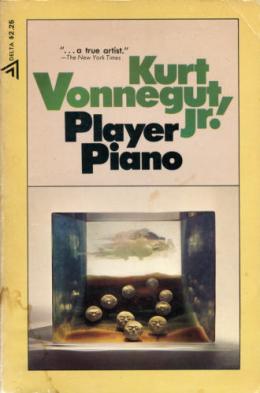
Novel: Player Piano

"a step backward, after making a wrong turn, is a step in the right direction.” 

Player Piano was Kurt Vonnegut's first published novel, and is set in the factory town of Ilium, New York in the near future. In this future scientists and engineers have created machines that now do the vast majority of tasks, leaving most people to either work for the reconstruction and reclamation corps or the army, neither of which serve a purpose besides occupying those who would otherwise be unemployed. Those who do have meaningful jobs by and large oversee the work of machines, which is the position that protagonist Paul Proteus is in when the novel opens. Whilst Proteus' future is bright and he outwardly seems to believe in the society in which he takes part he feels a growing sense of unease with the pointlessness of it all and the alienation of the common man, yearning for some way to break free. When an old friend, Ed Finnerty, comes to see Paul and announces he has left his job it sends Paul towards a revolutionary struggle against the system in a manner more than slightly reminiscent of Huxley's Brave New World.


Whilst the plot may not be original Vonnegut's inimitable style and the slightly closer to home setting of the novel turn it into a very different creature, acting more as a social satire than a heartfelt cry against the system. The machines in Player Piano are still punch card operated and it is not set in a future too far removed from the time when the book was published (1952), leading to a setting less detached from reality than many dystopian novels achieve, which lends weight to the sometimes irreverent style of the novel. The supporting characters are just as three dimensional as Proteus himself, with his wife and their relationship seeming truly plausible and human, and the feeling of despair and rootlessness that Proteus seems to feel resonate strongly with the reader, again helping to stop the book being simply a dry social commentary and instead making it a truly gripping story.


Player Piano is not nearly as polished as Vonnegut's later work, such as Slaughterhouse five, with a side story involving the Shah of a foreign country seeming particularly out of place, but all in all it holds up incredibly well and makes an interesting addition to the genre of dystopian fiction. By the end of the novel Player Piano Seems not to be anti-technology or anti-progress, but rather anti-stupidity, as only Vonnegut could envision.